Sorry,we moved.Your page will be redirected now...

we are now http://ghana-insider.com.we've rebranded.

POLITICS,BOTH INTERNATIONAL AND LOCALs.

FIRST HAND NEWS

ENTERTAINMENT NEWS.

WELCOME TO INEWSGH

READ IT HERE FIRST.

WE'RE HERE TO SERVE YOU

SPORTS NEWS.

THIS IS INEWSGH

GET TO KNOW IT FIRST,HERE.

Showing posts with label International News. Show all posts

Tuesday, 20 November 2012

Gaza ceasefire efforts stepped up


Israel has put plans for a ground operation in Gaza "on hold" to give talks to secure a truce with Hamas militants a chance, officials say.

It is understood Israel has set a Thursday deadline for the Egypt-brokered talks to succeed.

The current conflict began last Wednesday when Israel killed Hamas's military commander, saying it wanted to end rocket attacks on Israel.

More than 110 Palestinians and three Israelis have been killed so far.

Israeli ministers met late into the night to discuss Egyptian truce proposals, as officials are due to restart talks in Cairo.

Israeli troops are massed along the border, raising fears of a ground offensive similar to that of 2008-09.

However, Israeli officials say that any possible ground invasion of Gaza has been put on hold while the ceasefire talks continue.

A spokesman told the BBC that Prime Minister Benjamin Netanyahu had telephoned US President Barack Obama.

"Israel wants talks to succeed but we're prepared to go into Gaza," the spokesman said.


US Secretary of State Hillary Clinton is due in Israel for crisis talks.

Mrs Clinton was to underline that "the best way to solve this is through diplomacy, so that you have a peaceful settlement that ends that rocket fire and allows for a broader calm in the region", said Mr Obama's Deputy National Security Adviser Ben Rhodes.

Meanwhile, the UN Security Council is debating a statement calling on both parties to stop attacks and address humanitarian needs in Gaza.

BBC correspondents in Gaza reported that it had been a relatively quiet night, although the Israeli military said it had carried out about 100 strikes mainly on smuggling tunnels and underground rocket-launching facilities.

Hamas officials say 110 Palestinians have been killed by Israeli raids since Wednesday. Three Israelis have died as a result of rocket attacks.

A father and his two sons - thought to be two and four - were killed overnight, Hamas health ministry officials said.


On Monday, among those killed was a commander of the Islamic Jihad militant group who died in an air strike on a Gaza City tower block housing media organisations.

On Tuesday morning, 29 rockets were fired from Gaza toward Israel - three managed to get through Israel's Iron Dome interception system, Israeli officials said.

One landed on a parked bus in Beersheba and a house in Ofakim. There were no casualties.

Regional risk
UN Secretary General Ban Ki-moon met Arab League Chief Nabil al-Arabi in Cairo on Tuesday.

"I'm here to appeal personally for an end to the violence and to offer my ongoing efforts to achieve a ceasefire. I'm also here to offer my heartfelt condolences to many civilians, especially to families of victims who were killed," Mr Ban told a joint news conference.

He is due to travel to Israel later on Tuesday. Mr Ban warned against a ground operation in Gaza.

"Further escalating the situation will put the entire region at risk," he said.

Egypt has been trying to broker a ceasefire with the help of Qatar and Turkey.

Turkish Foreign Minister Ahmet Davutoglu and Arab foreign ministers are expected to visit Gaza on Tuesday.

The content of the Egyptian plan is not known, but both Israel and Hamas have presented conditions.
Israel's demands include no hostile fire of any kind from Gaza and international efforts to prevent Hamas from rearming, while Hamas is demanding an end to the blockade on Gaza and "Israel's assassinations".


The BBC's Kevin Connolly in Jerusalem says the Cairo talks - in which Egyptian intelligence officials are meeting separately delegations from Israel and Hamas - appear to be at a crucial stage.

It is the sequence of events involving the key measures of the plan, such as a cessation of attacks and easing the blockade on Gaza, that may prove a stumbling block, he adds.

Meanwhile, UN Security Council members have been debating a draft statement on Gaza and are awaiting a response from their governments.

On Monday, US President Obama spoke to his Egyptian counterpart Mohammed Mursi and Mr Netanyahu, discussing ways to de-escalate the situation, the White House said.

Khaled Meshaal, political leader of the Islamist movement Hamas which controls Gaza, said that a truce was possible in Gaza - as was further escalation of the conflict.

Hamas seized control of Gaza in 2007, a year after winning a decisive victory in general elections. Israel withdrew from the strip in 2005 but maintains a blockade around it.

Israel, as well as the United States and the European Union, regards Hamas as a terrorist organisation.

Source: BBC

Follow us on twitter @iNewsGh

Monday, 19 November 2012

Gaza crisis: Deaths soar amid fresh Israeli strikes


At least 18 people have died in the Gaza Strip as Israeli forces kept up air strikes they say are aimed at stopping rocket attacks into Israel.

Israeli officials said only one rocket was fired overnight, although some rocket fire resumed on Monday morning.

More than 90 Palestinians and three Israelis have died since Operation Pillar of Defence began on Wednesday.

The UN secretary general has called for an immediate ceasefire as he prepares to join truce talks in Egypt.

Israeli Prime Minister Benjamin Netanyahu said on Sunday he was ready to expand the operation, after Israel authorised the mobilisation of up to 75,000 army reservists.

Egyptian President Mohammed Mursi has said an Israeli ground invasion would have "serious repercussions", saying Egypt would never accept it "and neither will the free world".

The Arab League, which met in emergency session in Cairo on Sunday, is sending a delegation of foreign ministers to Gaza on Tuesday.

Target missed?

Israel's Defense Forces (IDF) said it had targeted around 80 sites overnight into Monday, including militant-owned buildings, weapons storage facilities and police stations, bringing its total to 1,350 sites targeted since Wednesday.

One of the overnight blasts destroyed a Hamas police headquarters.

As well as air strikes there was the rhythmic thud of shelling from Israeli warships, says the BBC's Jon Donnison in Gaza City.

On Monday morning, a rocket fired from Gaza hit a school in the Israeli city of Ashkelon, said the IDF. Classes had already been cancelled.

At least nine children were killed in Gaza on Sunday - the bloodiest day so far - and TV reports showing horrific images of their burned and bloodied bodies have been fuelling Palestinian anger, adds our correspondent.


In one strike nine members of the family of Hamas policeman Mohamed Dalou were killed.

Israel's Haaretz newspaper quoted IDF officials as saying the strike had hit a neighbour's house by mistake because of a "technical error". The IDF said it did not know what the Haaretz source was, but was looking into the report.

The army's chief military spokesman, Yoav Mordechai, told Israel's Channel 2 TV that the intended target of the strike had been Yehiya Rabiah, the head of Hamas's rocket-launching unit, but that there had been "civilian casualties".

UN Secretary-General Ban Ki-moon said he was deeply saddened by the deaths of the Dalou family and other Palestinians, while expressing alarm at the continued rocket fire from Gaza against Israeli towns.

"This must stop," he said in a statement released late on Sunday. "I strongly urge the parties to co-operate with all efforts led by Egypt to reach an immediate cease-fire."

Hamas's military wing said earlier: "The massacre of the Dalou family will not pass without punishment."

The charity Save the Children has said families in Gaza are running out of food and water, with most trapped in their homes, enduring power cuts of up to 18 hours a day.


War or peace?
Egypt has been leading efforts to broker a peace deal, with both senior Israeli and Hamas officials in Cairo for talks.

The BBC's Middle East editor, Jeremy Bowen, says he fears the conflict might get worse before any truce is agreed.

Since the conflict began, Gaza militants have fired 848 rockets towards Israel - 546 hit Israel, 302 were intercepted by the Iron Dome interceptions, the IDF says.

Before the recent offensive, Israel had repeatedly carried out air strikes on Gaza as Palestinian militants fired rockets across the border.

But the aerial and naval bombardment is its most intense assault on the territory since Israel launched a full-scale invasion four years ago.

Hamas seized control of Gaza in 2007, a year after winning a decisive victory in general elections. Israel withdrew from the strip in 2005 but maintains a blockade around it.
Israel, as well as the United States and the European Union, regards Hamas as a terrorist organisation.

source: BBC

follow us on twitter @iNewsGh

The shock of the (male) nude


An exhibition in Vienna probes our attitude towards nudity - people in the West have become accustomed to the naked female form, but male nudes can still shock. Before the show opened, the museum even covered up parts of its own posters, saying they had caused public outrage.

Five naked male statues on a pedestal confront you as you enter the new exhibition at the Leopold Museum.

The earliest is Ancient Egyptian, and the most recent a figure based on a shopping mannequin.

Tobias Natter, the director of the Leopold Museum, says the opening display is a "walk through 500 years of history".

"You have an old Egyptian nude, which is very unusual for Egyptian art, you have Roman art, you have Rodin from the 19th and 20th Century, to a postmodern statue. It tells the visitor the male nude in art has a very long tradition," he says.
The exhibition features a diverse range of styles, from paintings by Peter Paul Rubens, Paul Cezanne, Edvard Munch and the expressionist artist Egon Schiele, to more modern and sexually explicit works by the US photographer Robert Mapplethorpe and the London-based artists Gilbert and George. There are images of erect penises, and of anuses.

Natter says the museum is breaking new ground.


"It's quite unusual for an exhibition to focus on the depiction of the male nude. Surprisingly we had many exhibitions dealing with the female nude body, but so far never an exhibition which features the male nude. Somehow it is a taboo.

"On the other hand, we see that the male nude is getting a new presence in modern contemporary society. He is now on posters, he is on stages, he is getting more and more normal."

An image of naked woman is still regarded in a very different light from that of a naked man, Natter says.

"We saw with the advertising for our exhibition, there is still a difference between a female nude body on the poster or a male nude body. This makes a cultural difference that is still on-going and needs to be discussed with an exhibition."

One of the posters advertising the exhibit featured a full-frontal photograph of three naked footballers, by the French artists Pierre et Gilles. Shortly before the opening last month, the Leopold Museum said that it had received so many complaints that it had been forced to take action.
It put a red band covering the intimate parts of the footballers, on some - but not all - of the posters.
But Vienna is full of posters of naked or semi-naked women and is also known for its relaxed approach to nudity at mixed saunas and sunbathing areas. So did the pictures really cause outrage?

Erich Kocina, from Die Presse newspaper, says the museum expected to provoke controversy with the posters - but it went beyond that, causing serious offence to some Viennese.

"It's a mixture - 30% was marketing and 70% was genuine outrage," he says.

"I think we are just used to seeing naked women because they are used as objects of desire in advertisements and TV. Naked men are not that common - we are not used to seeing a penis. I think that is the main problem for people."

Art historian Eva Kernbauer, from the University of Applied Arts in Vienna, says male nudes have been around for a long time, but the way nude men and women have been depicted has always differed.


"To put it very simply, male nudity was closely linked to strength, invulnerability and heroism, the female nude to beauty and erotics," she says.

"Also, the 'Venus pudica' [the shameful Venus] was already developed in ancient Greece, so the depictions of female chastity and female nudity are historically deeply interlinked. The female nude is not threatening at all - female nudity is vulnerable, because it acknowledges the gaze of the beholder."

This classical model is still powerful today, she says. Female nudity is not only omnipresent, it is also unthreatening. Male nudity is more challenging.

"Male nudity is very often linked to the exposure of sexual organs - the penis - and this is often done in a way that responds to the classical model of aggression and strength.

"While the sexual organ in itself does not necessarily have to appear as threatening or aggressive, the difference from the dominant model of soft female nudity is great."

Despite a long search throughout Vienna, I can't find anybody deeply outraged by the naked posters.

One man tells me guardedly that he is not "highly appreciative" of the image.

"It's provocative, it's true," says a woman named Eva. "On the other hand it is looking back to the old days when nakedness was quite common [in art], so I think we should get used to it."

And others, such as Cecile, a tourist visiting from France, like the nudes.

"They are very well-built, they are sportsmen, it's not like ugly old men with a big belly, so they are pretty. It's nice to see."

source: BBC
Follow us on twitter @iNewsGh

Tuesday, 13 November 2012

Buchanan Duke: The man whose creation kills millions of people daily


It looks harmless enough - white, 8cm (3ins) long and about the width of a child's finger - but the cigarette is vilified like no other product. Who invented it and how much responsibility does he bear for the countless deaths it has caused?

US surgeon Alton Ochsner recalled that when he was a medical student in 1919 his class was summoned to observe an autopsy of a lung cancer victim. At that time, the disease was so rare it was thought unlikely the students would ever get another chance.

But by the year 2000, it was estimated that 1.1 million people were dying annually from the disease, with about 85% of those cases stemming from a single cause - tobacco.

"The cigarette is the deadliest artefact in the history of human civilisation," says Robert Proctor of Stanford University. "It killed about 100m people in the 20th Century."


But by the year 2000, it was estimated that 1.1 million people were dying annually from the disease, with about 85% of those cases stemming from a single cause - tobacco.

"The cigarette is the deadliest artefact in the history of human civilisation," says Robert Proctor of Stanford University. "It killed about 100m people in the 20th Century."


Jordan Goodman, the author of Tobacco in History, says that as a historian he is careful about pointing the finger at individuals, "but in the history of tobacco I feel much more confident saying that James Buchanan Duke - otherwise known as Buck Duke - was responsible for the 20th Century phenomenon known as the cigarette."

Not only did Duke help create the modern cigarette, he also pioneered the marketing and distribution systems that have led to its success on every continent.

In 1880, at the age of 24, Duke entered what was then a niche within the tobacco business - ready-rolled cigarettes. A small team in Durham, North Carolina, hand-rolled the Duke of Durham cigarettes, twisting the ends to seal them.

Two years later Duke saw an opportunity. He began working with a young mechanic called James Bonsack, who said he could mechanise cigarette manufacturing. Duke was convinced that people would want to smoke these neatly-rolled, perfectly symmetrical machine-made cigarettes.

Bonsack's machine revolutionised the cigarette industry.

"It's essentially a cigarette of infinite length, cut into the appropriate lengths by whirling shears," says Robert Proctor. The open ends meant it has to be "juiced-up with chemical additives". They added glycerine, sugar and molasses, and chemicals to prevent it drying out.


But keeping cigarettes moist was not the only challenge that Bonsack's contraption presented to Duke. While his factory girls typically rolled about 200 cigarettes in a shift, the new machine produced 120,000 cigarettes a day, about a fifth of US consumption at the time.

"The problem was he produced more cigarettes than he could sell," says Goodman. "He had to work out how to capture this market."

The answer was to be found in advertising and marketing. Duke sponsored races, gave his cigarettes out for free at beauty contests and placed ads in the new "glossies" - the first magazines. He also recognised that the inclusion of collectable cigarette cards was as important as getting the product right. In 1889 alone, he spent $800,000 on marketing (about $25m in today's money).

Bonsack retained the patent to his machine, but as thanks for Duke's support in developing it, he offered him a 30% discount on the lease.

This competitive advantage - coupled with vigorous promotion - was key to Duke's early success. As he had suspected, people liked mechanised cigarettes. They were modern-looking and more hygienic - one campaign emphasised this point over cigars, which were manufactured using human hands and saliva.

But although cigarette smoking in the US quadrupled in the 15 years to 1900, it remained a niche market, with most tobacco being chewed or smoked through pipes and cigars.

Duke - a cigar smoker himself - saw the potential for cigarettes to be used in places closed to cigars and pipes, such as drawing rooms and restaurants. The ease with which they could be lit and - unlike pipes - remain lit, also suited them to coffee breaks in modern city life.
"The cigarette was really used in a different way," says Proctor. "And it was milder - and this is one of the great ironies, that cigarettes were widely thought to be safer than cigars, because they are just 'little cigars', right?"

source: BBC

Follow us on twitter @iNewsGh

Monday, 12 November 2012

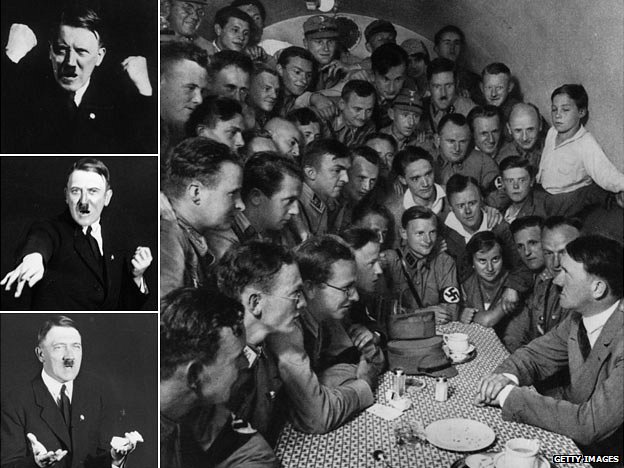
Viewpoint: The dark charisma of Hitler


Adolf Hitler was an unlikely leader but he still formed a connection with millions of German people, generating a level of charismatic attraction that was almost without parallel. It is a stark warning for the modern day, says historian Laurence Rees.

At the heart of the story of Adolf Hitler is one gigantic, mysterious question: how was it possible that a character as strange and personally inadequate as Hitler ever gained power in a sophisticated country at the heart of Europe, and was then loved by millions of people?

The answer to this vital question is to be found not just in the historical circumstances of the time - in particular the defeat of Germany in World War I and the depression of the early 1930s - but in the nature of Hitler's leadership.

It's this aspect of the story that makes this history particularly relevant to our lives today.

Hitler was the archetypal "charismatic leader". He was not a "normal" politician - someone who promises policies like lower taxes and better health care - but a quasi-religious leader who offered almost spiritual goals of redemption and salvation. He was driven forward by a sense of personal destiny he called "providence".

Before WWI he was a nobody, an oddball who could not form intimate relationships, was unable to debate intellectually and was filled with hatred and prejudice.

But when Hitler spoke in the Munich beer halls in the aftermath of Germany's defeat in WWI, suddenly his weaknesses were perceived as strengths.

His hatred chimed with the feelings of thousands of Germans who felt humiliated by the terms of the Versailles treaty and sought a scapegoat for the loss of the war. His inability to debate was taken as strength of character and his refusal to make small talk was considered the mark of a "great man" who lived apart from the crowd.

More than anything, it was the fact that Hitler found that he could make a connection with his audience that was the basis of all his future success. And many called this connection "charisma".

"The man gave off such a charisma that people believed whatever he said," says Emil Klein, who heard Hitler speak in the 1920s.

But Hitler did not "hypnotise" his audience. Not everyone felt this charismatic connection, you had to be predisposed to believe what Hitler was saying to experience it. Many people who heard Hitler speak at this time thought he was an idiot.

"I immediately disliked him because of his scratchy voice," says Herbert Richter, a German veteran of WWI who encountered Hitler in Munich in the early 1920s.

"He shouted out really, really simple political ideas. I thought he wasn't quite normal."

In the good economic times, during the mid-to-late twenties in Germany, Hitler was thought charismatic by only a bunch of fanatics. So much so that in the 1928 election the Nazis polled only 2.6% of the vote.

Yet less than five years later Hitler was chancellor of Germany and leader of the most popular political party in the country.

What changed was the economic situation. In the wake of the Wall Street Crash of 1929 there was mass unemployment in Germany and banks crashed.

"The people were really hungry," says Jutta Ruediger, who started to support the Nazis around this time. "It was very, very hard. And in that context, Hitler with his statements seemed to be the bringer of salvation."

She looked at Hitler and suddenly felt a connection with him.

"I myself had the feeling that here was a man who did not think about himself and his own advantage, but solely about the good of the German people."

Hitler told millions of Germans that they were Aryans and therefore "special" and racially "better" people than everyone else, something that helped cement the charismatic connection between leader and led.

He did not hide his hatred, his contempt for democracy or his belief in the use of violence to further political ends from the electorate. But, crucially, he spoke out only against carefully defined enemies like Communists and Jews.
Since the majority of ordinary Germans were not in these groups, as long as they embraced the new world of Nazism, they were relatively free from persecution - at least until the war started to go badly for the Germans.

This history matters to us today. Not because history offers "lessons" - how can it since the past can never repeat itself exactly? But because history can contain warnings.

In an economic crisis millions of people suddenly decided to turn to an unconventional leader they thought had "charisma" because he connected with their fears, hopes and latent desire to blame others for their predicament. And the end result was disastrous for tens of millions of people.

It's bleakly ironic that German Chancellor Angela Merkel was greeted in Athens recently with swastika banners carried by angry Greeks protesting at what they see as German interference in their country.

Ironic because it is in Greece itself - amid terrible economic crisis - that we see the sudden rise of a political movement like the Golden Dawn that glories in its intolerance and desire to persecute minorities.

And it is led by a man who has claimed there were no gas chambers in Auschwitz. Can there be a bigger warning than that?

source: BBC

Follow us on twitter @iNewsGh
Sunday, 11 November 2012

Viewpoint: What Chinese women really need

Mao Zedong once said that in China "women hold up half the sky". But decades on from the revolution that transformed Chinese society, writer Xinran asks whether women really have inherited all that was promised, as part of a series of features on challenges for China's new leaders.
At critical junctions, China likes to change driver as it continues its journey on the political road it was set upon in the 1950s.
Of course, the drivers are always men. This is a real "man-made" culture, even though Mao himself famously gave half the Chinese sky to women.
Since then that half-sky has been more about how women should stand up and liberate themselves, in line with global women's liberation movements.
The Chinese press will tell you that Chinese women have managed to claim that half-sky quite well - first of all by getting their names back after the 1,000-year old "marriage rules" which endured through centuries of feudalism. Chinese women now have the right to retain their maiden names.

Further, women have been freed from the expectation of an arranged marriage and won the right to pursue education, to compete for the same jobs as Chinese men and, most importantly, to be part of China's super-rich.
But you can still see and hear different stories in China's countryside and in one place in particular that I have visited, just a five-hour drive from the shining metropolis of Shanghai.
I have been back twice a year ever since I left in 1997. The Chinese women I have met and researched over the last 30 years or so are largely migrant workers and peasants.
Many factory girls have told me they are happy because their monthly income of less than $160 (£100) is much more than what villagers would get from working the land all year round.
But migrant mothers often express worries about their children having no school to go to in the city where they work, either because of the high cost (a school term costs over $1,600 - more than what they earn over three years) or the school's policy to only take children who are from that city.
So grandmothers in many of these countryside communities carry on working the land and looking after their grandchildren with aged painful bones.

Such women are not part of the picture of the new China that is being built up and they tell me they have no idea how to comprehend the city life they hear about from their city-worker children.
These Chinese women are an important part of the 1.3 billion Chinese - their lives are tough and they work very hard.
They are everywhere, shuttling between cities and countryside - but they are invisible to government policy and the respected education system is blind to them.
In a previous era China was too male-dominated to bother to even think about the women. Today's China is simply too busy to remember them.
I  finished my new book about the first generation of the country's one-child policy earlier this year. I struggled all the way to the end, mostly because I couldn't find information about these mothers from their children's memories to reconstruct a picture of family life.
This was because their parents were too busy to cook, read to them or even be with them; the children were too lonely to understand that they could have more from family besides inherited money.
Traditional Chinese family values have been corrupted not just by American dollars and European labels but also by those who choose only to follow the path to riches.
But what else have we lost?
I was born and raised in Red China when my parents both devoted their time and family life to the political party and country. They were encouraged to believe that parents should not care about their children more than their work.
My son Panpan was born in 1988 when China opened up to the world. I wanted to be different from my mother, to give my son a better childhood; therefore I was shocked when Panpan asked me to spend 10 minutes with him as his 12th birthday gift! This was a dream I recognised - as a child I wanted the same from my mother.

So, why? We grew up in such different times and places and yet have the same hunger for a mother's love and care. I don't think that was all down to the one-child policy.
But by 2025, there will be 20 million more young Chinese men than women, according to the National Bureau of Statistics - one ironic side-effect of the one-child policy will be the high value of these young women.
The women of China are important not just to the children who need them, but also for the country's future.
China has survived two critical and dangerous junctions in the past few decades. The first was allowing millions of peasants to flood into the cities without state control and the second was opening the door to the world without being beaten by other world powers.
Now China has arrived at the third junction. The 18th Congress is likely to appoint Xi Jinping as the country's new driver in the presidential post. As usual, everybody knows this fact before the "Chinese election".
Whatever he is going to do, I wish Mr Xi would be brave and strong enough not only to fight with the Chinese political mafia and free up some of the country's "cultural sky" for an open media, but also to take time to listen to Chinese women - and to bring true power to those extremely hard-working Chinese women living in poverty.
China would not be here today without those mothers and grandmothers; they should not be left in those forgotten corners.

source: BBC

Follow us on twitter @iNewsGh

Friday, 9 November 2012

Will China's new leader usher in a new world order? What should the US and Africa expect?


The central challenge for China and its relations with the wider world will be managing its own inexorable rise, writes former Australian Prime Minister and China expert Kevin Rudd as part of a series of features on challenges for China's new leadership.

Xi Jinping - the man most likely to become China's new president - appears to be a man very comfortable with the mantle of leadership.


He will take the helm at a time when China is emerging as the world's largest economy. This will be the first time since George III that a non-English speaking, non-Western, non-democratic state will dominate the global economic order.

Xi can have confidence in his family background, given the contribution of his father Xi Zhongxun to the Chinese revolution and to subsequent economic development. He has served in the Chinese military. He is confident of his economic credentials - holding senior positions in provincial administrations has given him the experience to manage the demands of economic development.

And over the last five years Xi has spent a lot of time deepening his understanding of international matters, most particularly China's relationship with the United States.

He is the sort of leader the US leadership can do business with as he seeks to continue China's modernisation while maintaining strategic stability in East Asia.


East Asian nationalism
What we know from economic history is that political power invariably flows from economic power and, over time, foreign and security policy power follow suit.

But the core challenge for China and the rest of the world will be managing the rise of China while maintaining and strengthening the current international rules-based order that has underpinned global strategic stability and economic growth since World War II.

The current order has served China well over the last 30 years during its reform and modernisation period.

It is in China's interests that this order continue into the future notwithstanding the fact that it was not an order constructed with Chinese participation but rather by victorious Western powers after the fall of Berlin.

While China's economic power has grown rapidly, its military capabilities are significantly less than those of the US. Militarily, the US will remain the world's only superpower until the middle of the century - that is, a power with truly global strategic reach.


But within the East Asian theatre or within the wider Indo-Pacific region, China's capacity is becoming greater. Chinese strategic capabilities, the force structure of its military together with its emerging military doctrine are aimed at supporting China's "core interests" - in which the Chinese include long-term political unity with Taiwan, and the protection of China's territorial and maritime claims in both the East China Sea and the South China Sea.

These claims are hotly contested by a large number of other regional states. Whereas the United States remains neutral on the merits of each of these claims and counter-claims, the South China Sea as well as the Diaoyu/Senkaku islands represent significant flashpoints for the future.

Political nationalism is alive and well across East Asia. Despite the fact that the economies of the region are increasingly integrated, the fires of political nationalism can easily be stoked. These in turn become increasingly difficult to manage for the governments of the region - be they democratically elected or otherwise.

The key challenge for the region therefore is to build regional security including confidence and security-building measures between the militaries. This is emerging as a crucial task for the East Asia Summit - the pan-regional institution with high-level political participation and an open political and security agenda.

Open global markets

Beyond the eastern hemisphere, there is an open question of how China will exercise its foreign policy influence across the world.

For the period ahead, it should always be remembered that China's paramount national objective is to complete the economic modernisation task for its nation and for its people. The centrality of this task governs much of China's foreign policy behaviour.

China wants global strategic stability to continue for the simple reason that conflict undermines prospects for economic growth.

China also wants to ensure continued access to global markets which have been so fundamental to the success of China's economic development so far. Over time, the Chinese leadership hope that domestic consumption will provide a much stronger driver of its own economic growth than international demand.

China has become concerned about the fragility of the global economy given its experiences with both the global financial crisis and the euro crisis. Nonetheless open trade and investment flows will remain important for China's medium-term economic future.


China also has a deep national political interest in becoming a respected global power. This therefore also goes to the heart of China's contributions to the stability of the global order.

Its position as a permanent member of the UN Security Council is already of pivotal significance, the ongoing Syrian crisis where China has continued its support for Russia's veto of substantive UNSC action on Syria highlights a continuing conflict within China's foreign and security policy establishment.


The foreign policy establishment is highly sensitive to international reaction to China supporting or protecting authoritarian regimes be they in Damascus, Tehran or Pyongyang; the security establishment is driven by one of the deep axioms of Chinese international policy from the inception of the People's Republic namely the principle of mutual non-interference.

China is, however, likely to become a more active participant in a full range of global institutions - social, economic, humanitarian and environmental.

China is already a significant contributor to UN peacekeeping operations around the world. And it has also developed a new international aid policy which, while different from that of developed countries (whose principles are driven by the Development Assistance Committee of the OECD) will nonetheless mean that China will become a more prominent player in aid relationships across the developing world.

China in Africa

This will be particularly evident across Africa where China has profound economy and foreign policy interests. China identifies Africa as an alternative source of energy and raw materials that are essential to the continuation of China's economic modernisation process.

Chinese foreign direct investment flows into the African continent will grow. This in turn will continue to generate domestic political controversies in various countries (most recently evidenced in Zambia) where local tensions have arisen concerning the returns to local communities from large-scale mining development.

Africa also remains significant for China's position within the developing world. In Africa there has been much debate around the so-called "Beijing Development Model" whereby successful economic growth through market reforms can be achieved without yielding to full-scale political liberalisation of the type seen in Western liberal democracies.

China therefore will continue to be a major economic and foreign policy player in each capital across the continent, including the African Union itself in Addis Ababa where China has just funded the construction of the new AU HQ exclusively from its own resources.

So will there be major foreign policy changes on the large questions facing the international community in the decade ahead? In broad terms, Chinese foreign policy will continue to follow the contours outlined above. There is therefore likely to be more continuity than fundamental change.

Nonetheless the core question for China will remain what influence it will seek to bring to bear on the future evolution of the global rules-based order itself.

If there is to be a change to the order, China has yet to articulate the conceptual and policy framework for it. The rest of the international community therefore has an opportunity (both for good and for ill) to help shape Chinese thinking during this most significant time.

Our core argument to our Chinese friends across the world should be to strengthen the existing order rather than allow it to become increasingly dysfunctional, let alone replace it with something else.

source: BBC
Please follow us on twitter @iNewsGh

Thursday, 8 November 2012

China congress: Hu Jintao opens party meeting on leadership change

Chinese President Hu Jintao has opened a Communist Party congress that begins a once-in-a-decade power transfer with a stark warning on corruption.

Addressing more than 2,000 delegates, Mr Hu said that a failure to tackle the issue "could prove fatal to the party".

China faced unprecedented opportunities and challenges, he said, and the nation should "aim higher and work harder".

His speech kicks off a week-long meeting that will see a new set of leaders unveiled.

Security is very tight across Beijing, with many dissidents detained or under house arrest, rights groups say.

Mr Hu told delegates at the Great Hall of the People that China had to adapt to a changing domestic and global environment.

"We must aim higher and work harder and continue to pursue development in a scientific way, promote social harmony and improve the people's lives," he said.

China's development should be made more balanced and sustainable, he said, and the "serious challenge" of corruption should be addressed.

"If we fail to handle this issue well, it could prove fatal to the party, and even cause the collapse of the party and the fall of the state," he said.

Anyone who broke the law would be brought to justice, "whoever they are and whatever power or official positions they have", he said.

The corruption warning echoed one delivered 10 years ago during the previous leadership transition, when the party was told it risked "heading for self-destruction" if it did not tackle the issue.

The months leading up to this congress have seen China's political leadership rocked by a scandal involving Bo Xilai, the former Chongqing party leader once seen as a candidate for top office.

His wife has been jailed for murdering a British businessman and he is expected to face trial on corruption-related charges.

Across China, meanwhile, recent cases of official corruption have stoked public anger and there have been a series of high-profile mass protests focusing on land grabs and environmental issues.

On the internet, thousands of people have called for better measures to fight corruption, leaving comments on websites launched for the congress by official media outlets Xinhua news agency, People's Daily and China Central Television (CCTV).

Economic growth has also slowed in recent months and the wealth gap is an issue of great concern, as is China's ageing population.

Mr Hu said a new model for economic growth was needed to respond to domestic and global changes.

"On the basis of making China's development much more balanced, coordinated and sustainable, we should double its 2010 GDP and per capita income for both urban and rural residents (by 2020)," he said.

Amid rumbling regional tensions over territorial rows in the East China and South China Sea, Mr Hu said the nation should "resolutely safeguard" maritime rights and become a maritime power.

"Active and prudent efforts" should be made to reform the political structure, he said, without giving details.
'Growing concerns'

The congress - for which no formal schedule has been revealed - will last a week and will be keenly observed for any indications of the leadership's future plans.

During the congress a new central committee is selected. It then chooses the country's highest decision-making body, the Standing Committee of the Politburo.

The process takes place behind closed doors, with the make-up of the top bodies in reality decided ahead of time.

The current Standing Committee has nine members, of whom seven including Mr Hu and Premier Wen Jiabao are expected to step down.

The other two members, Xi Jinping and Li Keqiang, are expected to become party leader and deputy respectively. Mr Xi is also expected to take over from Mr Hu as China's president in March 2013.

Ahead of the congress there has been speculation that the number of seats on the committee will be reduced from nine to seven.

Analysts say there has also been division at the very top of the leadership, with two rival factions jostling for position and influence.

Vice-Premier Wang Qishan, propaganda chief Liu Yunshan, party organisation chief Li Yuanchao and Vice-Premier Zhang Dejiang are thought to be the front-runners.

But the exact composition of the committee will not be clear until it is formally announced next week, likely on 15 November at a plenum expected to follow the congress.

In Beijing, more than 1.4 million volunteers have been brought in to help out with security for the congress.

Transport restrictions are in place, street vendors have been told to close and even the flying of kites has reportedly been banned.

Rights group Amnesty International says more than 130 political dissidents were unlawfully detained or placed under house arrest ahead of the meeting.

source: BBC

Please follow us on twitter @iNewsGh

'Super-Earth' Alien Planet May Be Habitable for Life


Astronomers have detected an alien planet that may be capable of supporting life as we know it — and it's just a stone's throw from Earth in the cosmic scheme of things.
The newfound exoplanet, a so-called "super-Earth" called HD 40307g, is located inside its host star's habitable zone, a just-right range of distances where liquid water may exist on a world's surface. And the planet lies a mere 42 light-years away from Earth, meaning that future telescopes might be able to image it directly, researchers said.
"The longer orbit of the new planet means that its climate and atmosphere may be just right to support life," study co-author Hugh Jones, of the University of Hertfordshire in England, said in a statement. "Just as Goldilocks liked her porridge to be neither too hot nor too cold but just right, this planet or indeed any moons that it has lie in an orbit comparable to Earth, increasing the probability of it being habitable."
HD 40307g is one of three newly discovered worlds around the parent star, which was already known to host three planets. The finds thus boost the star's total planetary population to six. [Video: Super Earth May Have Liquid Water]
Finding new signals in the data
The star HD 40307 is slightly smaller and less luminous than our own sun. Astronomers had previously detected three super-Earths — planets a bit more massive than our own — around the star, all of them in orbits too close-in to support liquid water.
In the new study, the research team re-analyzed observations of the HD 40307 system made by an instrument called the High Accuracy Radial velocity Planet Searcher, or HARPS.
HARPS is part of the European Southern Observatory's 11.8-foot (3.6 meters) telescope at the La Silla Observatory in Chile. The instrument allows astronomers to pick up the tiny gravitational wobbles an orbiting planet induces in its parent star.
The researchers' new analysis techniques enabled them to spot three more super-Earths around the star, including HD 40307g, which is thought to be at least seven times as massive as our home planet.
HD 40307g may or may not be a rocky planet like Earth, said study lead author Mikko Tuomi, also of the University of Hertfordshire.
"If I had to guess, I would say 50-50," Tuomi told SPACE.com via email. "But the truth at the moment is that we simply do not know whether the planet is a large Earth or a small, warm Neptune without a solid surface."
A jam-packed extrasolar system
HD 40307g is the outermost of the system's six planets, orbiting at an average distance of 56 million miles (90 million kilometers) from the star. (For comparison, Earth zips around the sun from about 93 million miles, or 150 million km, away.)
The other two newfound exoplanets are probably too hot to support life as we know it, researchers said. But HD 40307g — which officially remains a "planet candidate" pending confirmation by follow-up studies — sits comfortably in the middle of the star's habitable zone.
Further, HD 40307g's orbit is distant enough that the planet likely isn't tidally locked to the star like the moon is to Earth, researchers said. Rather, HD 40307g probably rotates freely just like our planet does, showing each side of itself to the star in due course.
The lack of tidal locking "increases its chances of actually having Earth-like conditions," Tuomi said.
The new study has been accepted for publication in the journal Astronomy & Astrophysics.
A candidate for direct observation
Super-Earths have been spotted in other stars' habitable zones before. For example, a team using NASA's prolific Kepler Space Telescope announced the discovery of the potentially habitable world Kepler-22b in December 2011.

Kepler-22b lies 600 light-years away, which is not terribly far considering that our Milky Way galaxy is about 100,000 light-years wide. But HD 40307g is just 42 light-years from us — close enough that future instruments may be able to image it directly, scientists say.
"Discoveries like this are really exciting, and such systems will be natural targets for the next generation of large telescopes, both on the ground and in space," David Pinfield of the University of Hertfordshire, who was not involved in the new study, said in a statement.


Follow us on twitter @iNewsGh

Wednesday, 7 November 2012

Obama second term: What it means for the world

1. MIDDLE EAST

The BBC's Middle East editor Jeremy Bowen writes: In his victory speech, President Obama told Americans that 10 years of war were ending. But turbulence in the Middle East means that military action, perhaps even new wars, will push back on to his agenda.

The Syrian war is leaking into neighbouring countries. Second-term President Obama is likely to authorise more support of the Syrian rebels, short of direct US military intervention.

An even bigger decision awaits on Iran. If by next summer the US and its key allies still believe that Iran is developing a nuclear weapon, despite talks and sanctions, Mr Obama will have to decide whether or not to attack Iran's nuclear sites, or to give Israel a green light to go to war.

America has to build new relations with Arab countries that have elected Islamist political leaders, and to respond if the Arab uprisings continue to spread to US allies in the Gulf. Another crisis between Israel and the Palestinians is overdue. When it comes, Mr Obama will be tempted to revive the push for peace he abandoned in his first term.

Behind every decision will be the knowledge that, despite its huge military power, America's political leverage in the Middle East is in decline.

2. EUROPE

The BBC's Chris Morris in Brussels writes: Europe will be waking up this morning with a general sigh of relief. Opinion polls have always shown President Obama to be more popular than Governor Romney across the continent - but for most governments, too, continuity in Washington is better than a changing of the guard. The US Treasury Secretary Tim Geithner - as well as the President himself - has been closely involved in discussions on the eurozone. The EU is so embroiled in its internal debates on the eurozone crisis that it doesn't want any external distractions.

The EU has also been working closely with the Obama administration on a variety of foreign policy issues - Iran in particular. Even if some of the key personnel change in a second Obama term, the President's victory means there will be no dramatic change of course for European capitals to deal with.

3. CHINA

The BBC's Martin Patience in Beijing writes: President Obama's victory comes just a day before the start of China's once-in-a-decade leadership change, so for China's leaders the focus for now is firmly at home - and not across the Pacific.

But during the US presidential campaign, both candidates were highly critical of China, taking Beijing to task over what they saw as the country's unfair trade practices. Some of the sting from those accusations could well linger long after election day. Relations between the two countries have been strained in recent years - particularly over economic issues.

Beijing is also deeply worried about President's Obama strategic "pivot" back to Asia. Some officials believe that Washington is trying to contain the rise of China. It will be these issues that will dominant arguably the most important diplomatic relationship in the world.

4. AFGHANISTAN 

The BBC's Quentin Sommerville in Kabul writes: Much in Afghanistan is viewed now through the prism of the ending of the US-led combat mission here. A change in Commander-in Chief was unlikely to make much of a difference to American policy - there was little difference between the candidates, aside from Mitt Romney's claim that he would listen more to generals on the ground.

The question facing President Obama is how quickly do the remaining troops come home, and how many are left here after 2014. Military commanders would like a more gradual withdrawal, and a force of 10,000 plus to remain. But the White House, with a renewed mandate, is likely to press for an accelerated exit, with fewer American soldiers and marines remaining to assist Afghan forces, after 2014.

5. IRAN

The BBC's Mohsen Asgari in Tehran writes: Many in Iran were concerned that a Republican win would mean war, and believe a Barack Obama victory makes life safer for the people, because the US will move quickly to set up a new round of talks over Iran's nuclear ambitions.

However, some Iranian political activists believe that Barack Obama's victory will give rise to more pressures on Iran. "Barack Obama enjoys considerable popularity in the international community, which Romney really lacks, and it will help him reinforce the coalition against Iran and build up more pressure on the country," said Naser Hadian, a political professor at Tehran University.

Which would be more acceptable for Iran: Mr Romney and his Israeli allies imposing a cessation of uranium enrichment or a President Obama who might give Iran peaceful nuclear rights? From that viewpoint, Iranians are very happy to see Barack Obama once again in the White House.

6. PAKISTAN 

The BBC's M Ilyas Khan in Islamabad writes: Pakistan's military, which controls the country's national security policy, has traditionally felt more comfortable with Republican governments in the US. Democratic leaders, on the other hand, have tended to be rather cold towards it, due to its position civil liberties, democracy and nuclear weapons.

During President Obama's first term, US-Pakistan relations appeared to have hit rock bottom. The US continued to express concern over Pakistan's alleged support for militant groups. Pakistan remained angry over drone strikes on its territory, the killing of Osama bin Laden in a covert US operation on Pakistani soil, and Nato attacks on some Pakistani border posts.

But Mr Obama's victory means the US' proposed "end game" in Afghanistan is likely to pick up steam, and from a Pakistani perspective, take on a clearer shape. Pakistan has been complaining that American strategy in Afghanistan is vague, and that its own potential role as an important player in the Afghan peace is being ignored.

Analysts here predict that the Obama victory is likely to increase pressure on the Pakistani establishment to facilitate US goals in Afghanistan.

7. AFRICA

The BBC's Andrew Harding in Johannesburg writes: President Barack Obama made only one, cursory trip to sub-Saharan Africa during his first term. So how much will change in Mr Obama's second term? That question was, perhaps understandably, barely mentioned in an election campaign that focused on pressing domestic issues and the Arab uprisings.

Behind the scenes, American diplomacy will no doubt continue to be furiously in demand. The start of the second term is likely to be preoccupied with more of the same: international efforts to remove Al-Qaeda-linked rebels from the north of Mali - by force or negotiation or both - and efforts to ensure that Zimbabwe and Kenya avoid repeating the violence that wrecked their last elections.

So far, there is no sign of a grand "Obama Doctrine" for Africa - and perhaps that's a good thing, given the diversity and complexity of the continent. Mr Obama has left it to others to warn about the dangers posed by an insatiable China, but his second term may give him an opportunity to move away from the distorting "war on terror" preoccupations of Mali and Somalia, and focus on the broader issues - trade in particular - that he raised three years ago in Ghana.

8. RUSSIA

The BBC's Steve Rosenberg in Moscow: Russia has received the news of President Obama's re-election with cautious optimism. Moscow feels it knows President Obama: it has worked with him the last four years. And, after all, he is the man who famously launched the re-set in US-Russian relations.

But this will be no "buddy-buddy" relationship. President Obama may have hit it off with the previous Russian leader, Dmitry Medvedev (they once went to a burger bar together), but relations with Mr Putin are proving more challenging. There is concern in Washington at the current human rights situation in Russia; at the same time, there is suspicion in the Kremlin that the US is funding and supporting President Putin's opponents.

Add to all of this Moscow's concern at US plans for a missile defence shield in Europe, Nato's potential further enlargement to the east and major differences over the conflict in Syria, and it is clear the mutual distrust is growing. Time for a re-set of the re-set?

SOURCE: BBC


Obama re-elected as US President


President Barack Obama has been re-elected to a second term, defeating Republican challenger Mitt Romney.

America's first black president secured the 270 votes in the electoral college needed to win the race.

In his victory speech before supporters in Chicago, Mr Obama said he would talk to Mr Romney about "where we can work together to move this country forward".

Mr Obama prevailed despite lingering dissatisfaction with the economy and a hard-fought challenge by Mr Romney.

His Democrats also retained their majority in the Senate, which they have held since 2007, while Republicans kept control of the House.


The BBC's Mark Mardell in Chicago says the president is challenging his opponents, asking them to work with him.

With Florida's 29 electoral votes still undecided, Mr Obama won 303 electoral votes to Mr Romney's 206.

The popular vote, which is symbolically and politically important but not decisive in the race, remains very close.

Mr Obama greeted jubilant supporters and congratulated Mr Romney and Republican vice-presidential candidate Paul Ryan on their hard-fought campaign.

"We have picked ourselves up, we have fought our way back and we know in our hearts that for the United States of America the best is yet to come," he said.


Mr Obama said he was returning to the White House "more determined, and more inspired than ever about the work there is to do, and the future that lies ahead".

He pledged to work with Republican leaders in Congress to reduce the government's budget deficit, fix the tax code and reform the immigration system.

"We are an American family and we rise and fall together as one nation," he said.

In Boston, where his campaign was based, Mr Romney congratulated the president and said he and Mr Ryan had "left everything on the field" and had given their all in the campaign.


Referring to the struggling economy, Mr Romney said that now was not the time for "partisan bickering and political posturing", and that Republicans and Democrats must "put people before politics".

"I so wish that I had been able to fulfil your hopes to lead the country in a different direction but the nation chose another leader and so I join with you to earnestly pray for him and for this great nation," he said.

Under the US constitution, each state is given a number of electoral votes in rough proportion to its population. The candidate who wins 270 electoral votes - by prevailing in the mostly winner-takes-all state contests - becomes president.

On Tuesday, the president held the White House by assembling solid Democratic states and a number of important swing states such as Colorado, Iowa, Pennsylvania, Michigan, Minnesota, Virginia and Wisconsin. His narrow victory in Ohio, a critical Mid-Western swing state, sealed the victory.


Billions spent
Mr Romney won North Carolina and Indiana, both of which Mr Obama won in 2008, as well as the solid Republican states.

But he was unable to win in Ohio or other states needed to breach the 270 threshold.

Also on Tuesday's ballot were 11 state governorships, a third of the seats in the 100-member US Senate and all 435 seats in the House of Representatives.

Mr Obama's victory came despite lingering high unemployment - 7.9% on election day - and tepid economic growth.

But voters gave him credit for his 2009 rescue of the US car industry among other policy accomplishments, and rewarded him for ordering the commando mission that killed Osama Bin Laden in Pakistan last year.

He and Mr Romney, as well as their respective allies, have spent more than $2bn (£1.25bn) - largely on adverts in swing states.

source: BBC


Monday, 5 November 2012

US set for final campaigning day


US presidential rivals Barack Obama and Mitt Romney are approaching the final day of their election battle in a frantic fight for swing state votes.

Mr Obama is scheduled to appear in Madison, Wisconsin, accompanied by Bruce Springsteen, before going on to Iowa and Ohio.

Mr Romney is due in Florida - where polls suggest he is ahead - in Virginia, New Hampshire and Ohio.

Analysts say the election will come down to a handful of swing states.

Mr Obama and Mr Romney are running almost neck-and-neck in national polls, but polls of many key battlegrounds show Mr Obama narrowly ahead.

However, neither camp is exuding absolute confidence, the BBC's North America editor Mark Mardell reports.


The campaign has been most intense in Ohio, which no Republican has ever lost and still made it to the White House.

The pair spent Sunday addressing crowds across the country, with Mr Romney speaking in Pennsylvania, a state his aides insist he can now win on Tuesday.

Mr Obama held rallies in New Hampshire and Florida and carried on to Ohio and Colorado in the evening.

In Florida, Democrats have filed a legal case demanding an extension of time available for early voting, citing unprecedented demand.

In Ohio, Republican election officials will go to court on Monday to defend an 11th-hour directive to local election officials.

Last month, a federal appeals court reinstated early voting on the last three days before Tuesday's election.


The ruling overturned a state law saying early voting should end on the Friday before the election, making an exception only for voters living overseas and for military personnel, who tend to favour Republican candidates.

Critics say this potentially favours the Obama camp.

Race 'tightening'

A final poll published on Sunday by Ohio's Columbus Dispatch gave Mr Obama a 2% lead - 50% to 48% - over his rival, within the margin of error.

Both candidates visited the Buckeye State on Sunday, with Mr Romney telling crowds in Cleveland that Mr Obama has failed in his pledge to be a "post-partisan" president and criticising his record.

"He's been divisive, blaming, attacking, dividing and - by the way - it's not only Republicans that he refused to listen to, he also refused to listen to independent voices."

Later on Sunday, he spoke in Morrisville, Pennsylvania, his first visit there in the final stages of the campaign. Democrats say the Romney team's last-minute decision to campaign in the state is a sign of desperation, but polls do show a tightening race.

"The people of America understand we're taking back the White House because we're going to win Pennsylvania," Mr Romney told the crowd in Morrisville.

Mr Obama made another appearance in Cincinnati, Ohio, where Stevie Wonder opened a huge evening rally.

Earlier in the day at a rally in Concord, New Hampshire, Mr Obama said: "We have come too far to turn back now."

He said he would work across party lines to break the political gridlock in Washington, but would not compromise on priorities such as healthcare and college financial aid.

Activists have been stepping up efforts across the crucial swing states.

In Wisconsin, student volunteers have been putting in 14-hour days in an effort to deliver the state for Mr Obama, the BBC's Paul Adams reports from Madison.

An opinion poll on Sunday for ABC News and the Washington Post put the two candidates at 48%, with even voters who term themselves independents split evenly on 46%.

Mr Romney remains favoured among whites, seniors and evangelical Christians; Mr Obama among women, non-whites and young adults.

The president also remains slightly ahead in most of the nine-or-so swing states that will determine the election.

The president also remains slightly ahead in most of the nine-or-so swing states that will determine the election.

Opinion polls published on Saturday showed him well-placed in Iowa, Nevada and Ohio, but most remain within the polls' own margins of error.

The election is run using an electoral college. Each state is given a number of votes based on its population. The candidate who wins 270 electoral college votes becomes president.

source: BBC


Leave your comment below

Twitter Delicious Facebook Digg Favorites More